(コリアデイリー/ニューヨーク中央日報 韓国語 2019/08/09)
ニューヨーク州で『東海併記』と韓日関係の歴史教育が施行される。
ニューヨーク州トビー・アン・スタビスキー(Toby Ann Stavisky)(民主・16選挙区)上院議員とエドワード・ブラウンスタイン(Edward C. Braunstein)(民主・26選挙区)下院議員、そして韓人団体は8日、スタビスキー議員のフラッシング事務所で会見を開き、ニューヨーク州教育局[NYSED New York State Education Department]が学校に『東海(East Sea)』を『日本海(Sea of Japan)』と併記および韓国と日本の歴史的背景を説明するように勧告したと明らかにした。
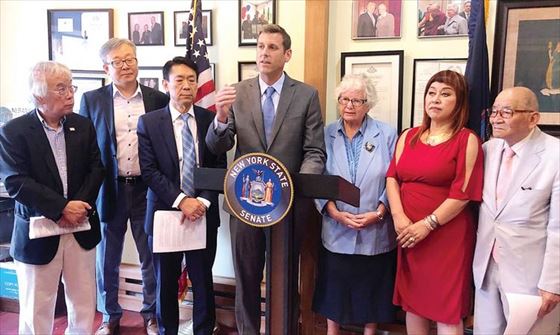
▲8日、トビー・アン・スタビスキー,ニューヨーク州上院議員(右から3番目)の事務所で開かれた会見で、エドワード・ブラウンスタイン州下院議員(演壇)が東海表記に関する州教育局の新しい方針を説明している。
6日、教育局はチャータースクールを含む公立校の校長など高位関係者たちに書簡を送り、「教師が韓日間の水域を『東海』と『日本海』として併記して言及することを推奨し、地理的位置を教えることに加えてさらに細心の注意を傾けなければならない」と勧告した。
書簡によれば、各学区で教科書および教科過程、進行速度などを定めることができるが、社会科目の場合、歴史的重要性を反映する用語を区分して使わなければならない。新しい政策は書簡が発送された6日から施行されている。ただ、教師が学生たちにこの事項を教えなくても処罰されることはない。
今回の政策は、スタビスキー議員とブラウンスタイン議員が去る5月8日、教育局ベス・ベルリン(Beth Berlin)局長代行[acting commissioner]などとの会議を経て施行されることができた。ブラウンスタイン議員は「東海表記が韓国人社会に重要な問題で、学生たちに正確な歴史的事実を知らせることが重要だという点を強調した」と説明した。
東海表記のために、これまで多くの議員が数回法案を上程したが、いつも下院を通過することができなかった。
スタビスキー議員は「教育局が東海の名前を認めたことがとてもうれしい」とし「法案の通過はなくとも結局、学生たちに正しい情報を教えることができるようになった」と伝えた。
スタビスキー議員は「教育局が東海の名前を認めたことがとてもうれしい」とし「法案の通過はなくとも結局、学生たちに正しい情報を教えることができるようになった」と伝えた。
ニューヨーク韓人学父母協会チェ・ユンヒ(Choi YoonHee)会長は「特に日本の貿易報復で韓日関係が敏感なこの時点に良い便りを得て、より一層うれしい」と話した。
一方、ブラウンスタイン議員は次の会期にも『東海併記』法案を上程する計画だ。会見にはニューヨーク韓人会、市民参加センター、韓人権益伸長委員会、韓人老人有権者連合会など団体代表が参加した。(機械翻訳 若干修正)
州教育局の通達の内容を見ると韓国の言い分そのままですね。
・韓国と日本の間の海を東海と日本海と呼ぶことを推奨
・両方の名前の歴史的な重要性に敏感でなければならない
・2000年以上にわたり世界中の人々が東海と見なしていた
・東海の名は1929年にIHOが「海洋と海の境界」を出すまでは古い日本の地図を含み世界の地図にあった
・韓国は1910年から1945年まで日本に占領されていたのでIHOの意思決定プロセスに参加できず、「海洋と海の境界」では日本海のみが使用された
| THE STATE EDUCATION DEPARTMENT / THE UNIVERSITY OF THE STATE OF NEW YORK / ALBANY, NY 12234 Deputy Commissioner Office of Instructional Support 89 Washington Avenue - Room 875 EBA Albany, New York 12234 To: Superintendents of Public Schools District Superintendents of BOCES Principals of Charter and Other Public Schools From: Dr. Kimberly Young Wilkins Subject: Updated Guidance for Sea of Japan/East Sea Date: August 6, 2019 New York State has a long history of providing guidance to school districts for developing conceptual and critical thinking in Social Studies. In addition, students should be able to apply these ideas to every day experiences. Although the State Board of Regents sets the learning standards (what a student should know and be able to do), curriculum decisions, including which textbooks to use in the classroom, local lessons, and the pace of the instruction, are locally decided by the school districts. With the ongoing implementation of the NYS Social Studies Learning Standards and related Framework, school districts across the State must reflect on the use of terminology that has historical significance to different countries, groups, or individuals. One such example is the use of the term Sea of Japan, which, when referenced within lessons or curriculum materials, has also been called the East Sea. The New York State Social Studies Framework does not specifically refer to the Sea of Japan or the East Sea; however, while teaching about this geographical location, school districts should be sensitive and responsive to the historical significance of both names. The NYSED recommends teachers refer to the body of water on the eastern boundary of Asia between Korea and Japan as both the East Sea and the Sea of Japan. For more than 2,000 years, not just Koreans, but people throughout the world, viewed the body of water on the eastern boundary of Asia between Korea and Japan as the East Sea. In order to resolve the controversy, in 2019, the International Hydrographic Organization (IHO) reportedly urged Japan to negotiate with the Republic of Korea. The IHO was founded in 1921 to standardize the names of seas and oceans and support safe navigation of ships. The name the East Sea was on world maps, including old Japanese maps, until the publication of S-23 “the Limits of Oceans and Seas” by IHO in 1929. During the time when the IHO was creating a list of the names of oceans and seas, Japan had occupied and imperialized Korea starting in 1910 and ending in 1945. Accordingly, Korea was unable to participate in the decision-making process. As a result, only the name Sea of Japan was used in the publication, which fueled the spread of the name on world maps and in textbooks. This practice remained in the second (1937) and third edition (1953) of the publication of S-23 “the Limits of Oceans and Seas” because Korea was either under Japanese rule from 1910 to 1945 or engaged in a war from 1950-1953, the time of the publications. There are many examples where school districts, BOCES, etc. should be cognizant of terminology that has historical significance and meaning to different communities. If you have any questions or concerns, please feel free to contact the NYSED Office of Curriculum and Instruction at 518-474-5922. |


 しました


specificasia
が しました